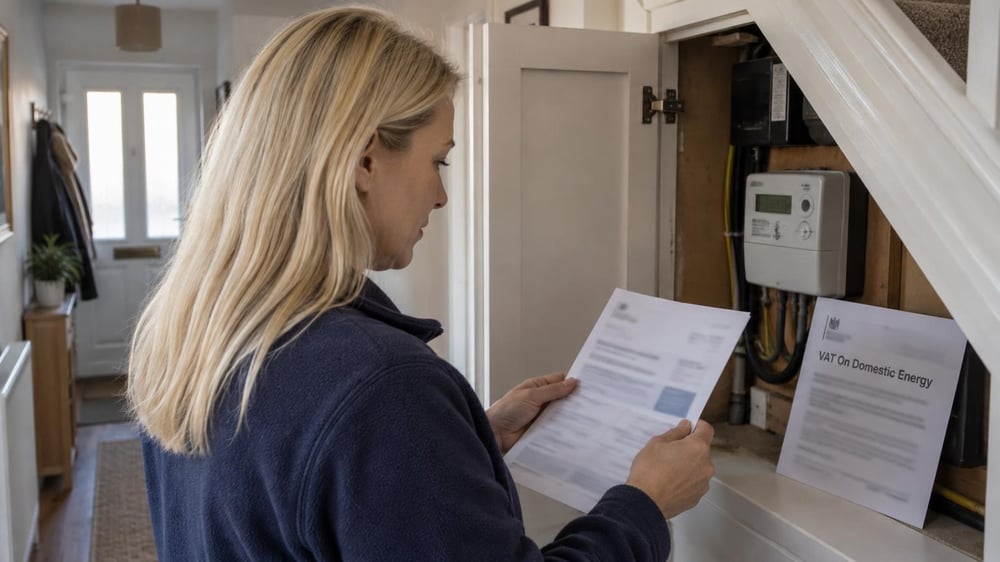
Chancellor John Healey confirmed in his first Budget on 28 October 2026 that the temporary removal of VAT on domestic energy will be extended until July 20271. The measure, which had been due to end earlier, now runs into the seventh month of next year2.
The Wales Office said the extension applies to household electricity bills and runs "for three months, to 30 June 2027"3. The Guardian reported the VAT cut on electricity bills was extended "until next July"4, and This is Money said it was extended "until July 2027"1. The sources give slightly different end dates, 30 June 2027 and July 2027, and do not reconcile them. Age UK, in guidance published on 10 September 2026, said the reduction from 5% to 0% on electricity bills was due to run from 1 October 2026 until 31 March 2027, and that it applies to all tariffs, including fixed deals5.
"The UK government will extend 0% VAT on household electricity bills for three months, to 30 June 2027."
The Budget also set out other measures with a direct bearing on household bills. The 5p cut to fuel duty is extended for a further six months until 30 June 20273. The 4% tariff on kerosene is removed, which the government says will support the 105,000 Welsh households that rely on heating oil3. Tariffs are axed on over 100 food products, including chocolate and fruit juice, which combined with earlier suspensions will save households up to £21 annually3. The National Living Wage rises by 3.9% to £13.21 per hour, and the National Minimum Wage by 3.9% to £11.27 per hour for 18 to 20-year-olds and to £8.31 per hour for 16 to 17-year-olds and eligible apprentices3.
Separately, the Guardian reported that 20 million households in council tax bands A to D in England would receive a £100 payment, at a cost of £2.6bn, with equivalent funding for Scotland and Wales, whose governments can decide whether to replicate it4. Healey described the VAT and council tax measures as "£50 off VAT, £100 off council tax for this winter 2 tax cuts"2.
Why it matters for households
The VAT removal applies to domestic electricity, so its value depends on how much electricity a household uses. This is Money reported that the extension benefits households able to charge electric vehicles at home, and that government forecasts put the saving for those with driveways and EV chargepoints at £40 a year1. The same article said legislation will clarify that electricity supplied through publicly accessible and workplace EV chargepoints remains subject to 20% VAT and does not qualify as domestic energy use for Climate Change Levy purposes1. It reported that for an estimated nine million people in properties without a driveway, the extra cost of relying on public charging rather than home charging exceeds £1,000 a year1.
The VAT change sits alongside movement in the price cap. The House of Commons Library said the cap will rise by 4% in the fourth quarter of 2026 and is forecast to rise by a further 9% in the first quarter of 2027, and that the electricity figures include the effect of removing VAT from electricity bills for six months from October 20266. Under the July to September 2026 direct debit cap the average annual bill for typical gas and electricity consumption is £1,6636.
What happens next
The VAT removal is time-limited, with the sources giving 30 June 20273 or July 20271 as the end point. The fuel duty cut runs until 30 June 20273. The £100 council tax band A to D payment in England, and equivalent funding for the devolved governments, was announced on 28 October 20264. Further detail on how the VAT treatment of public charging will operate has not been reported beyond the clarification described above1. General information on how tax works is in our tax guide.
Sources6 cited
- Chancellor's bid to tackle higher public EV charging costs fails to plug a £1,000-a-year 'driveway divide' | This is Money thisismoney.co.uk
- John Healey extends October change for households with driveways until July 2027 - Birmingham Live birminghammail.co.uk
- Budget 2026: Breathing space for Welsh families and businesses - GOV.UK gov.uk
- Healey gives households £100 to help navigate ‘global economic storms’ | Budget 2026 | The Guardian theguardian.com
- Government help with energy bills - cost of living | Age UK ageuk.org.uk
- Gas and electricity prices during the 'energy crisis' and beyond - House of Commons Library commonslibrary.parliament.uk
 GOV.UKOfficial information on tax, benefits and government services
 MoneyHelperFree, impartial money and pensions guidance, set up by government
 Citizens AdviceFree advice on money, consumer and legal problems in England and Wales
 Turn2usFree benefits calculator and grants search from a charity
 Citizens Advice ScotlandFree advice across Scotland