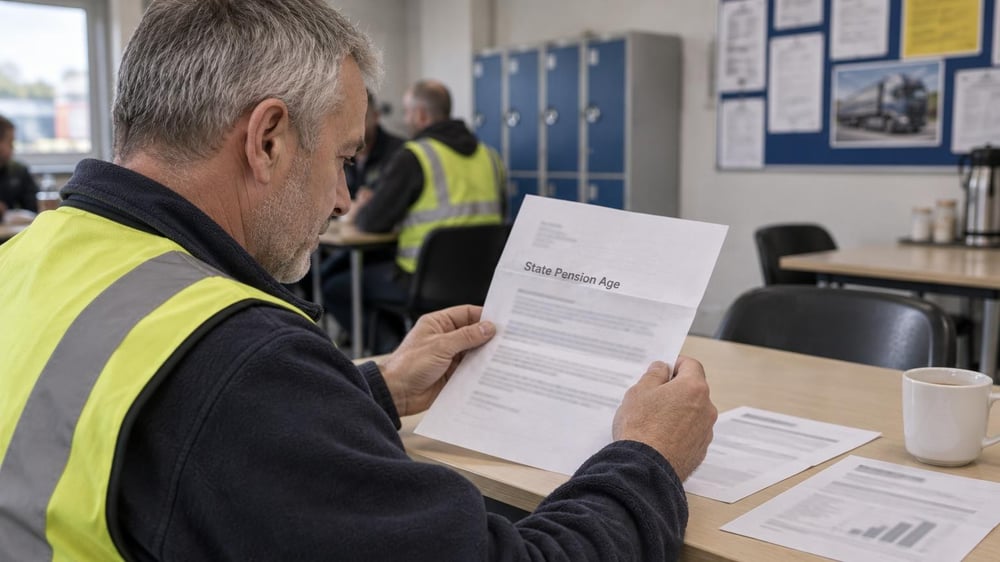
The Department for Work and Pensions has confirmed the next groups affected by the rise in state pension age from 66 to 67, which is being applied in phased one-month steps and will finish in 20281. The change affects anyone born on or after 6 April 19601.
Under the timetable, people born between 6 November 1960 and 5 December 1960 reach state pension age at 66 years and 8 months, and each later birth month adds a further month of delay1. The DWP said the Pensions Act 2014 brought the increase from 66 to 67 forward by eight years1.
"The Government also changed the way in which the increase in State Pension age is phased so that rather than reaching State Pension age on a specific date, people born between 6 April 1960 and 5 March 1961 will reach their State Pension age at 66 years and the specified number of months."
| Birth date | State pension age |
|---|---|
| 6 November 1960, 5 December 1960 | 66 years and 8 months |
| 6 December 1960, 5 January 1961 | 66 years and 9 months |
| 6 January 1961, 5 February 1961 | 66 years and 10 months |
| 6 February 1961, 5 March 1961 | 66 years and 11 months |
| 6 March 1961, 5 April 1977 | 67 years |
Source: DWP timetable as reported1
The DWP said that for people born after 5 April 1969 but before 6 April 1977, state pension age was already 67 under the Pensions Act 20071. A further rise to 68 is planned for 2044 to 20461. The government's second periodic review of state pension age sets out plans for a further review within two years of the next Parliament, which will reconsider the rise to 68, and the government said it remains committed to providing 10 years' notice of changes1. Baroness Neville-Rolfe's report recommended that the proportion of adult life people should on average expect to spend in retirement should be up to 31%, and that the government should set a limit on state pension-related expenditure of up to 6% of GDP; on those metrics state pension age would rise to 68 between 2041 and 20431.
Separately, the full rate of the new state pension was £221.20 a week, or £11,502.40 a year, before a 4.1% rise in April 2025 took it to £230.30 a week, or £11,975 a year2. The basic state pension was £169.50 a week in 2024-25 (£8,814 a year), with the same 4.1% increase raising it to £176.45, or £9,1752. The rise followed the triple lock, under which payments increase by whichever is higher of September CPI inflation (1.7%), average earnings growth (revised from 4% to 4.1%) or 2.5%2.
Why it matters for households
The date someone can start claiming their state pension is set by their date of birth, not by when they stop working. For people born in the months covered by the DWP timetable, the wait extends by one month for each later birth month, up to a state pension age of 67 for those born from 6 March 1961 to 5 April 19771. That delay affects when state pension payments begin and how many qualifying years of National Insurance contributions someone can build before claiming. The full new state pension requires at least 35 qualifying years, and at least 10 years are needed to get anything at all2. People who reached state pension age before April 2016 need 30 years of contributions for the full basic state pension2.
What happens next
The phased increases continue until the timetable finishes in 20281. A further state pension age review is planned within two years of the next Parliament and will reconsider the rise to 681. The date of that review, and whether it changes the 2044 to 2046 timetable, has not been reported.
You can check your own state pension age using the guide on what your State Pension age is, and see how payments are uprated under the triple lock. The new State Pension explained sets out the qualifying rules, and you can read about your National Insurance record and how to check your State Pension forecast.
 Pension WiseFree guidance on your options for a defined contribution pension, from age 50
 FSCSProtects your money if a bank, insurer or investment firm fails
 GOV.UKOfficial information on tax, benefits and government services