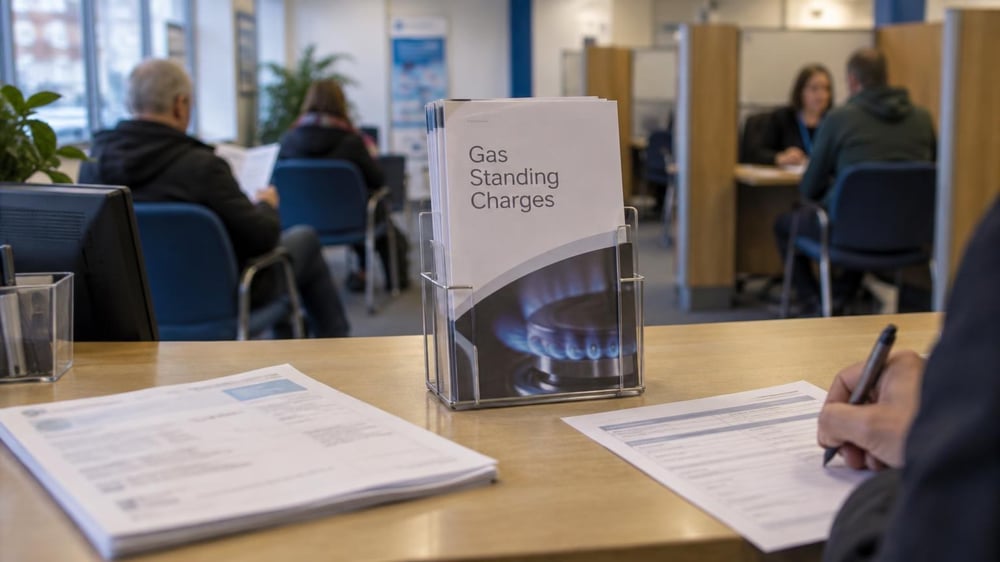
Chancellor John Healey announced on 28 October 2026 that gas standing charges will be removed from household bills for around 23 million homes, and that he will ask Ofgem to deliver the change in 2027 or as soon as possible after1. The government said the charges are £108 a year for the typical household on average, and that moving the fixed costs onto the unit rate could save 60% of account-holding households around an average of £45 off their annual bill1. Which? reported the current price cap for households paying by direct debit has an average gas standing charge of 30p a day, or £109 over a year, and an average electricity standing charge of 55p a day, or £201 over a year2.
A standing charge is a fixed daily fee added on top of a household gas bill regardless of how much gas has been used, so a household could use no gas at all and still pay it1. The government said households not seeing an automatic saving will still have better control over their bills, and that it will set out targeted mitigation for a small number of households in due course1.
"The Chancellor will announce today an end to this unfair and outdated practice. He will ask Ofgem to deliver removal of these charges, which are £108 a year for the typical household on average, in 2027 or as soon as possible after."
The figures given for the charge differ slightly: the government cites £108 a year for the typical household1, Which? puts the average annual gas standing charge at £1092, and Birmingham Live describes the charges as worth £1103. The timing is also stated differently: the government and Which? both give "in 2027 or as soon as possible after"1, while a note in the government's methodology refers to fixed costs being paid on the unit rate "by the end of next year"1.
The same Budget included a one-off £100 payment for households in Council Tax bands A-D, paid through council tax accounts rather than energy suppliers, at a cost of £2.6bn, with local authorities instructed to start making payments in January 20272. The temporary removal of 5% VAT on domestic electricity, due to end on 1 April 2027, was extended to the end of June 2027; the government estimates the extension will take £50 off the annual price cap for a typical household, or around £4 a month2.
Why it matters for households
Removing the standing charge does not remove the cost. The government said the fixed costs will instead be paid on the unit rate1, and Which? noted that energy companies are likely to increase unit rates to recoup the costs, so households that use less gas would save money while households with high gas usage may end up paying more2. Dr Craig Lowrey of Cornwall Insight said the change is "a broadly progressive move" that may help lower-income households who tend to use less energy, but that higher unit rates mean people in badly insulated homes, larger families or those keeping the heating on to manage a health condition could end up paying more3. The change applies to gas only; Which? reported the Chancellor suggested a similar reform would follow for electricity bills but did not say when2.
What happens next
Ofgem must work out the detail; Fraser said it will not be until next year that households really understand the effect3. The £100 payments are due to start in January 20272, and the electricity VAT cut now runs to the end of June 20272. The government said targeted mitigation for a small number of households will be set out in due course1. Further detail on how the change affects bills is covered in our guide to cutting household bills.
Sources3 cited
- Chancellor abolishes standing charges on gas bills to make payments fairer - GOV.UK gov.uk
- £100 energy payments and no gas standing charges: How the Budget will change your energy bills - Which? which.co.uk
- DWP state pensioners 'to pay more' warning after big John Healey update - Birmingham Live birminghammail.co.uk

 Financial Ombudsman ServiceFree, independent help when a complaint about a firm is not put right
 FSCSProtects your money if a bank, insurer or investment firm fails
 FCA Warning ListCheck whether a firm is authorised before you deal with it
 MoneyHelperFree, impartial money and pensions guidance, set up by government
 Citizens AdviceFree advice on money, consumer and legal problems in England and Wales