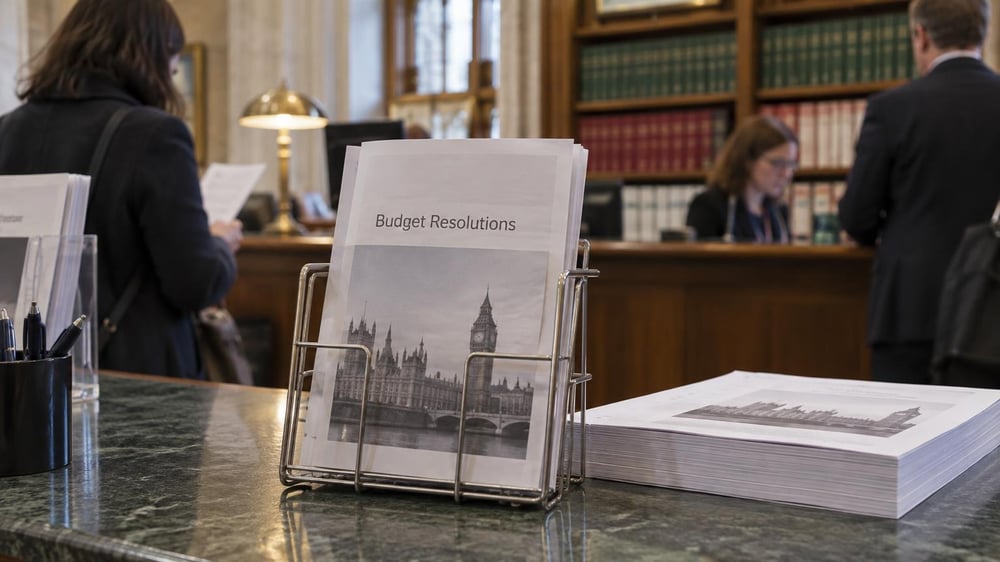
The Commons considered each of the ways and means resolutions tabled after Chancellor John Healey's Budget, which he presented to the House on 28 October 20261. Most resolutions were agreed to "on the nod", meaning no formal vote occurred, but divisions took place on seven measures1. All seven were agreed to, and the Finance Bill 2026-27 was read a first time, formally introducing it to Parliament1.
The government had introduced 108 ways and means resolutions covering the measures due to be included in the Finance Bill, a procedural step needed before the bill could be introduced1. The Budget debate ran from 28 October to 3 November, at the end of which the House was asked to vote on each resolution1.
| Resolution | Provision | Result |
|---|---|---|
| 3 | Increase in the income tax rate for property and savings | Agreed to (337 ayes to 180 noes) |
| 7 | Increase in the rate of the bank corporation tax surcharge | Agreed to (420 ayes to 105 noes) |
| 8 | Decrease in the lifetime limit of the Business Asset Disposal Relief (capital gains tax) | Agreed to (348 ayes to 176 noes) |
| 15 | Charges connected with employment visas non-taxable benefits | Agreed to (414 ayes to 106 noes) |
| 55 | Clarifying that public electric vehicle charging is liable for VAT at the standard rate (20%) | Agreed to (324 ayes to 88 noes) |
| 76 | Increase of the rates of alcohol duty | Agreed to (331 ayes to 181 noes) |
| 86 | Introduction of an additional tax on 'high-value properties' (the High Value Council Tax Surcharge) | Agreed to (327 ayes to 161 noes) |
The corresponding clauses in the Finance Bill are clauses 3 and 4 for resolution 3, clause 7 for resolution 7, clause 8 and schedule 1 for resolution 8, clause 15 for resolution 15, clause 52 for resolution 55, clause 83 for resolution 76, and Part 3 (clauses 97 to 115) with schedules 12 and 13 for resolution 861.
"On 3 November, the House considered each of the resolutions the Chancellor tabled after the Budget."
Not every Budget measure is in this bill. HMRC's overview of tax legislation and rates sets out measures not included in the Finance Bill currently before the House, including changes to approved mileage rates, which the government says it will introduce via secondary legislation, and changes to the taxation of foreign sovereign investments, planned for a future finance bill1. The introduction of a mileage-based charge on electric and hybrid vehicles (electric vehicle excise duty, eVED) was first announced at Budget 2025 and will come into effect from April 20281.
Why it matters for households
The resolutions cover tax changes that affect people's money directly: the income tax rate on property and savings income, the lifetime limit for Business Asset Disposal Relief under capital gains tax, VAT treatment of public electric vehicle charging, alcohol duty rates, and a new High Value Council Tax Surcharge on high-value properties. The Commons Library briefing does not give the rates, thresholds or start dates for these measures beyond those noted above; those details have not been reported here. The resolutions are procedural approvals, and the measures take legal effect through the Finance Bill as it passes through Parliament. The tax pages explain how the tax system works.
What happens next
The Finance Bill 2026-27 has been read a first time and its text is published on parliament.uk1. The Treasury Select Committee held evidence sessions on the Budget and the OBR's forecast on 3 and 4 November 2026, and will take evidence from the Chancellor on 11 November 20261.
Sources1 cited
- Budget 2026 and Finance Bill 2026-27 - House of Commons Library commonslibrary.parliament.uk

 GOV.UKOfficial information on tax, benefits and government services
 MoneyHelperFree, impartial money and pensions guidance, set up by government
 Citizens AdviceFree advice on money, consumer and legal problems in England and Wales
 Turn2usFree benefits calculator and grants search from a charity
 Citizens Advice ScotlandFree advice across Scotland